
What Happens When the Search Engine Becomes the Real Estate Portal?
Here’s the uncomfortable truth nobody wants to say out loud: The biggest real estate portal in the world isn’t a real estate company. It never was. It’s Google. And last month, Google stopped pretending otherwise.
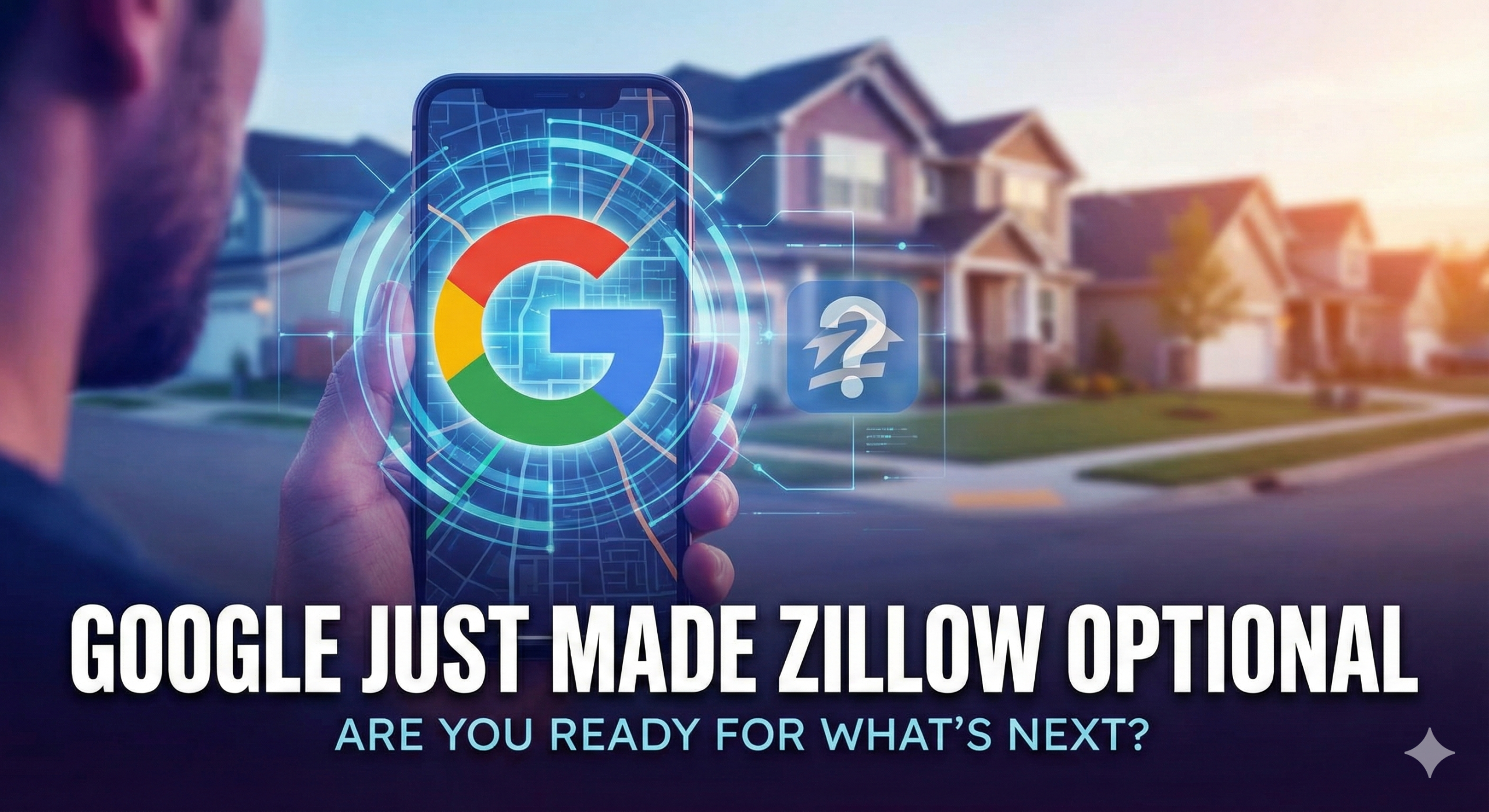
In December 2025, Google began testing MLS-powered home listings directly in mobile search results. Not links to Zillow. Not ads for Realtor.com. Actual property listings—complete with photos, prices, bedroom counts, and a shiny “Request a Tour” button—served up before users ever see a portal.
Let that sink in. The moment a buyer types “homes for sale in Austin,” Google now shows them the house. The interface. The lead capture. The call-to-action. All before Zillow even gets a chance to load.
This isn’t search anymore. This is distribution. And if you’re a real estate professional who depends on digital visibility to generate leads, this changes everything.
What Google Is Actually Testing
Real estate analyst Mike DelPrete was among the first to report on this experiment. According to his analysis, Google’s test includes full property detail pages, tour request functionality, and direct agent contact options—the exact features that power Zillow’s entire business model.
The test is currently live in select markets including Chicago, Denver, Austin, Houston, Los Angeles, Miami, and the Bay Area. It appears only on mobile browsers—for now.
Google partnered with HouseCanary, an AI-enabled brokerage licensed in all 50 states, through their ComeHome platform. HouseCanary subscribes to MLS feeds and provides the listing data that Google displays.
Here’s what the test includes:
- Property photos, prices, and addresses displayed directly in search results
- Full listing details including bedrooms, bathrooms, and square footage
- “Request a Tour” buttons for immediate lead capture
- Links to contact buyer’s agents
The market noticed. Zillow’s stock dropped over 8% on December 15, 2025, when news of the test broke. CoStar (which owns Homes.com) fell 6.4%. Even Rocket Companies, which acquired Redfin, declined 2.8%. According to HousingWire, industry analysts have long viewed Google’s entry into real estate as a “tail risk” to established portals.
Why is This Google Real Estate Experiment Different?
Google has dabbled in real estate before. They’ve tested different formats, launched products, and quietly shut them down. What makes this different?
Timing. Google has spent the past two years aggressively integrating AI into search through AI Overviews—those generated summaries that appear at the top of results. The data on what’s happening to click-through rates is brutal.
According to Pew Research Center, when AI Overviews appear in search results, users are significantly less likely to click on any link. A Seer Interactive study found organic click-through rates dropped 61% and paid CTR crashed 68% when AI summaries were present.
Now apply that pattern to home search. If Google can answer the buyer’s first questions—what’s available, what it costs, how many bedrooms—without sending them anywhere else, why would they ever click through to Zillow?
This is the “zero-click” future that publishers have been warning about. Except now it’s coming for real estate.
Where Do the Leads Actually Go?
When someone clicks “Request a Tour” on Google’s new listing format, where does that lead end up?
This is the million-dollar question—literally. Right now, the test routes through HouseCanary’s ComeHome platform. But what happens when (not if) Google scales this? Will listing agents get first access to tour requests on their own listings? Will buyer’s agents bid for placement? Will Google create an entirely new lead marketplace that sits between consumers and agents?
Victor Lund, managing partner of WAV Group, has raised serious concerns about how this test interacts with existing MLS rules. In his analysis, he argues that IDX—the framework that allows brokers to display other brokers’ listings—was never designed for this. “When listings appear inside paid Google ads, they are being promoted, targeted, and monetized in a third-party environment that sits outside the IDX framework,” Lund wrote.
Translation: Google is using your MLS data in ways the industry never agreed to. And if this stands, the rules of the game change entirely.
Feeling overwhelmed by these changes? You’re not alone. The agents who will thrive in this new landscape are the ones who start adapting their marketing strategy now—before Google’s test becomes Google’s standard. Reach out to learn how AI-powered marketing workflows can help you stay visible no matter where the leads come from.
What This Means for Agents and Brokers
Let’s be direct about what’s at stake.
If you’ve built your lead generation strategy around Zillow Premier Agent, Realtor.com, or any portal advertising, you’re now facing platform risk you didn’t sign up for. Not risk from those platforms—risk to those platforms from the company that sends them most of their traffic.
Goldman Sachs analysts noted that while Zillow’s direct traffic (people going straight to Zillow.com) provides some insulation, Google’s move represents “a long-term risk for real estate portals.” The key word is “long-term.” But in technology, long-term timelines compress fast.
Here’s what agents should be thinking about:
- Your digital visibility is now multi-platform. It’s not enough to rank on Zillow or show up in Google search results. You need to understand how AI systems decide what to display—and position your brand to be “machine-preferred.”
- Lead attribution just got more complicated. When Google routes a tour request, how will you know it came from Google vs. Zillow vs. your own website? Your CRM and tracking systems need to evolve.
- Speed to lead matters more than ever. If Google serves leads to multiple agents simultaneously, the first responder wins. This is where AI automation stops being optional.
- Brand authority becomes critical. When AI systems curate options, they favor trusted sources. Your reputation, reviews, and online presence influence whether algorithms recommend you.
The Bigger Picture: When the Interface Becomes the Marketplace
Here’s the contrarian take that might keep you up at night.
We’ve spent years debating which portal would win—Zillow or CoStar’s Homes.com or Realtor.com. But what if the real winner isn’t a portal at all? What if it’s the interface layer that sits on top of everything?
Google controls how 8.5+ billion daily searches get answered. They control what information appears first. And now they’re testing whether they can satisfy the home search query without sending users anywhere else.
If Google’s AI learns which listings get engagement, which agents get clicks, which price ranges generate tour requests—they don’t need to be a real estate company. They become the gatekeeper to every real estate company.
This is what “machine-preferred” signals means. Your marketing isn’t just competing for human attention anymore. It’s competing for algorithmic attention. And the algorithms don’t care about your 20 years of experience or your local market knowledge. They care about engagement metrics, click patterns, and conversion signals.
What “Top of Funnel” Means Now
For years, real estate marketing followed a clear funnel. Buyers started their search on Google, clicked through to a portal, browsed listings, requested information, and eventually contacted an agent. You invested in visibility at each stage.
But what happens when the first three stages collapse into one? When a buyer’s search query gets answered, their listing options get displayed, and their tour request gets captured—all before they leave Google?
The top of the funnel isn’t the portal anymore. It’s the AI-powered interface. And if you’re not visible there, you don’t exist in the buyer’s consideration set.
This is why agents who dismiss AI as “hype” or “not relevant to real estate” are making a strategic mistake. The platforms that control discovery are all-in on AI. Your visibility on those platforms increasingly depends on how AI systems evaluate and rank your content.
Practical Steps to Take Now
So what do you actually do with this information? Here’s where to start:
Audit your digital presence for AI discoverability. When someone searches for agents in your market, what comes up? Not just on Google—but on ChatGPT, Perplexity, and other AI interfaces? These platforms are increasingly where buyer journeys begin.
Invest in speed-to-lead automation. AI-powered lead response systems aren’t a luxury anymore. If Google starts routing tour requests to multiple agents, the fastest response wins. Tools that handle initial contact, qualification, and scheduling while you’re sleeping become essential.
Build brand authority that algorithms trust. Reviews, consistent content, accurate business listings, and engagement signals all feed into how AI systems rank options. Treat your online reputation as infrastructure, not marketing.
Diversify your lead sources. If you’re 100% dependent on any single platform—Zillow, Google Ads, social media—you’re exposed. The agents who weather disruption have multiple lead channels working simultaneously.
Start learning how AI systems “think.” The rules of SEO are evolving into the rules of AI optimization. Understanding how these systems evaluate content, authority, and relevance gives you an edge over agents who don’t.
The Bottom Line
Google’s test might fail. It might get shut down like previous experiments. Industry pushback on IDX compliance might force changes. We genuinely don’t know how this plays out.
But here’s what we do know: The trend line is clear. Search interfaces are becoming transactional interfaces. AI systems are becoming gatekeepers. And the agents who understand this shift—and start adapting now—will be positioned to thrive regardless of which specific platform wins.
The question isn’t whether AI will change how buyers find agents. That’s already happening. The question is whether you’ll be visible when they search.
Ready to Future-Proof Your Lead Generation?
The shift from portal-based discovery to AI-powered interfaces isn’t coming—it’s here. And the real estate professionals who adapt their marketing strategies now will have a significant advantage over those who wait.
We specialize in helping agents, brokers, and teams implement AI-driven marketing workflows that work across platforms. From lead response automation to AI-optimized content strategies to multi-channel visibility systems—we help you build marketing infrastructure that doesn’t break when the platforms change.
Contact us today to learn how we can help you implement AI marketing strategies that keep you visible, responsive, and competitive—no matter where Google or anyone else takes the industry next.
Sources
- Mike DelPrete: Google Enters the Portal Wars
- HousingWire: Google enters portal wars with MLS listings
- The Real Deal: Google’s Home Listings Experiment Raises Industry Eyebrows
- Pew Research Center: Google users are less likely to click on links when an AI summary appears
- RISMedia: Google Brings Listings Straight to Search
- The Close: Google’s Real Estate Listings Could Reshape Lead Gen
AI Disclosure: This article was generated with the assistance of AI and may contain inaccuracies or incorrect facts. While we strive for accuracy, readers should verify critical information independently. The views expressed represent analysis of publicly available information and should not be considered professional advice.